

For decades, lead qualification followed a fairly predictable process.
A prospect filled out a form. Marketing automation assigned a score. A sales development representative reviewed the lead, asked a few questions, and determined whether the opportunity deserved attention.
The system was never perfect.
Sales teams spent time chasing unqualified leads. Buyers filled out forms before they were ready. Valuable opportunities sometimes disappeared because nobody recognized their intent quickly enough.
AI agents are beginning to change that model.
And unlike previous automation waves, this shift is not simply about efficiency.
It is about transforming how qualification happens in the first place.
The Traditional Qualification Process Has Friction Everywhere
Most B2B service firms rely on signals that only appear after a prospect takes action.
For example:
- downloading a resource
- booking a meeting
- completing a contact form
- responding to outreach
- attending a webinar
The problem is simple.
By the time these signals appear, the buyer journey is often well underway.
In many cases, prospects have already:
- researched vendors
- compared alternatives
- built internal consensus
- narrowed their shortlist
The qualification process starts late because visibility starts late.
AI Agents Will Observe Intent Earlier
AI agents operate differently.
Instead of waiting for prospects to identify themselves, they can analyze patterns that indicate buying intent long before a form submission occurs.
These signals may include:
- research behavior
- topic exploration
- recurring questions
- content engagement
- vendor comparisons
- category investigations
Over time, AI agents become increasingly capable of identifying where a buyer sits within the decision-making process.
The question shifts from:
“Did this prospect fill out a form?”
to:
“How close is this prospect to making a decision?”
That is a much more valuable insight.
Lead Scoring Will Become Lead Understanding
Traditional lead scoring often relies on simple rules.
A webinar attendance receives points.
A whitepaper download receives points.
A website visit receives points.
The result is a numerical score that frequently lacks context.
AI agents introduce something different.
They can evaluate:
- buyer intent
- urgency
- business context
- problem awareness
- solution readiness
Instead of assigning a score, they build a richer picture of the opportunity.
That allows teams to prioritize leads based on actual likelihood rather than arbitrary engagement metrics.
The Discovery Conversation May Happen Before Sales Gets Involved
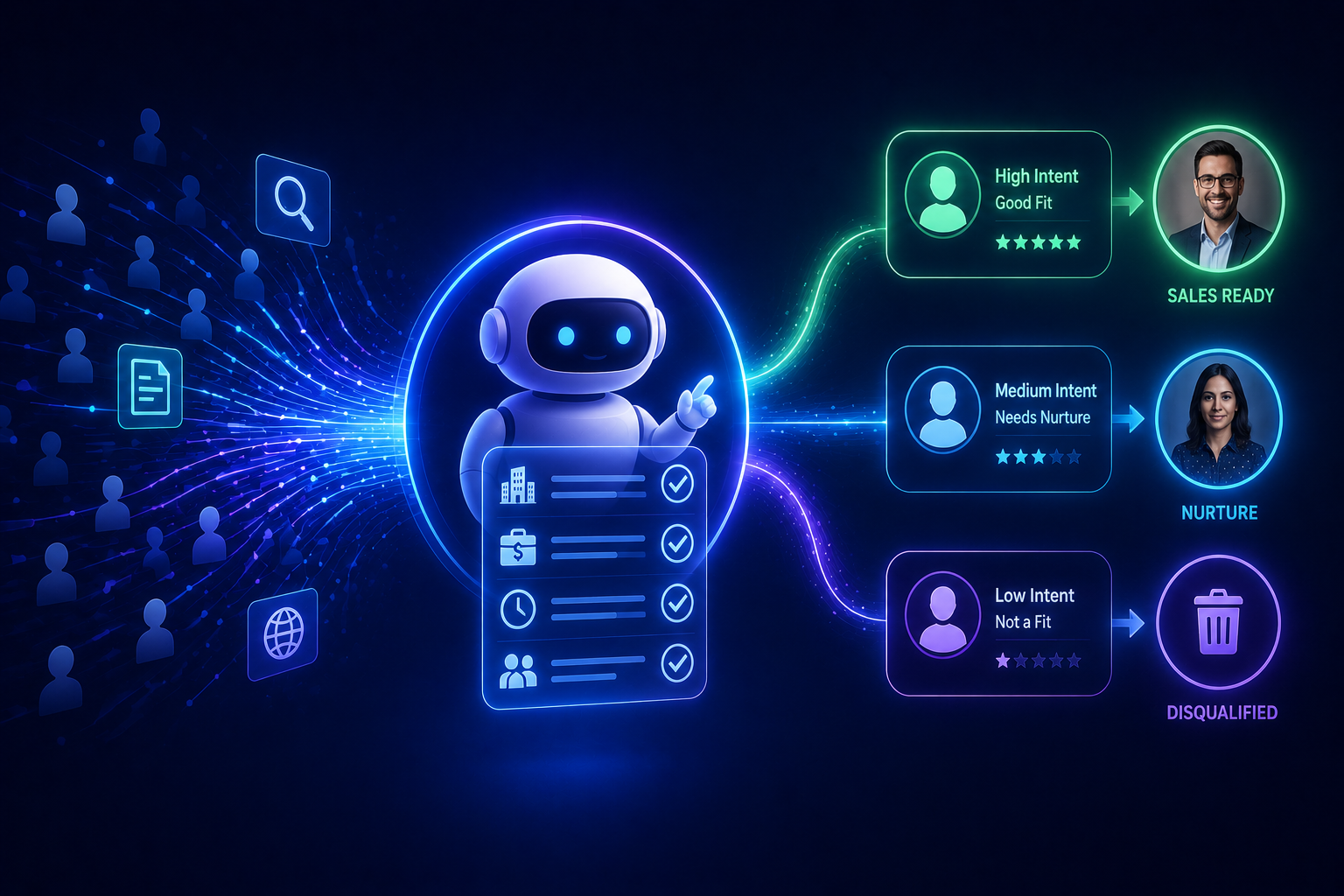
One of the most significant changes is that AI agents will increasingly handle early qualification conversations themselves.
A potential buyer may arrive on a website and begin asking questions.
Instead of filling out a form, they interact with an AI agent that can explore:
- business challenges
- objectives
- timelines
- budget considerations
- implementation requirements
The conversation feels helpful rather than interrogative.
Meanwhile, the service provider receives a much clearer understanding of the opportunity.
By the time a human conversation begins, much of the qualification work is already complete.
B2B Services Have a Unique Advantage
This shift may be particularly important for service-based businesses.
Unlike product companies, service firms often sell expertise, strategy, and outcomes rather than standardized features.
That means qualification requires understanding:
- business complexity
- organizational maturity
- strategic priorities
- stakeholder alignment
AI agents are well suited to gathering and organizing this information.
They can identify patterns across conversations and surface insights that help sales teams focus on opportunities with the strongest fit.
Response Speed Will Become a Competitive Advantage
Modern buyers expect answers immediately.
Waiting days for follow-up emails increasingly feels outdated.
AI agents create continuous availability.
Prospects can explore questions, evaluate fit, and receive guidance whenever they choose.
As a result:
- engagement increases
- friction decreases
- qualification happens faster
Companies that respond instantly often gain an advantage before competitors even enter the conversation.
The Best Qualification Systems Will Feel Less Like Qualification
Ironically, the most effective AI-driven qualification experiences may not feel like qualification at all.
Traditional processes often focus on extracting information.
AI agents can focus on providing value.
The interaction becomes:
- educational
- consultative
- problem-focused
- personalized
Buyers receive useful guidance.
Companies receive better qualification insights.
Both sides benefit.
What This Means for Marketing Teams
Marketing teams will need to rethink how they define a qualified lead.
Future qualification systems will rely less on:
- form completions
- gated content
- arbitrary scoring models
And more on:
- demonstrated intent
- contextual understanding
- conversation quality
- buying readiness
The organizations that adapt first will develop a much clearer picture of who is ready to buy and why.
The Future of Lead Qualification
Lead qualification is moving from data collection to intelligence generation.
Instead of asking buyers to identify themselves repeatedly, AI agents will help businesses understand prospects through context, behavior, and conversation.
The result is a qualification process that is:
- faster
- more accurate
- less intrusive
- more useful for buyers
For B2B service providers, this shift may become one of the most important changes in the sales process over the next few years.
Because the companies that understand buyer intent first will often be the companies that win the opportunity.hat infrastructure will be the ones answer engines understand first.
About Xeo Marketing
Xeo Marketing is a Toronto-based digital strategy and innovation agency specializing in AI Engine Optimization (AEO), helping B2B service businesses adapt to AI-powered search and discovery. The AI Visibility Score is the first module in AOME (AI Orchestrated Marketing Engine), launching throughout 2025.
Learn more at xeo.marketing
