

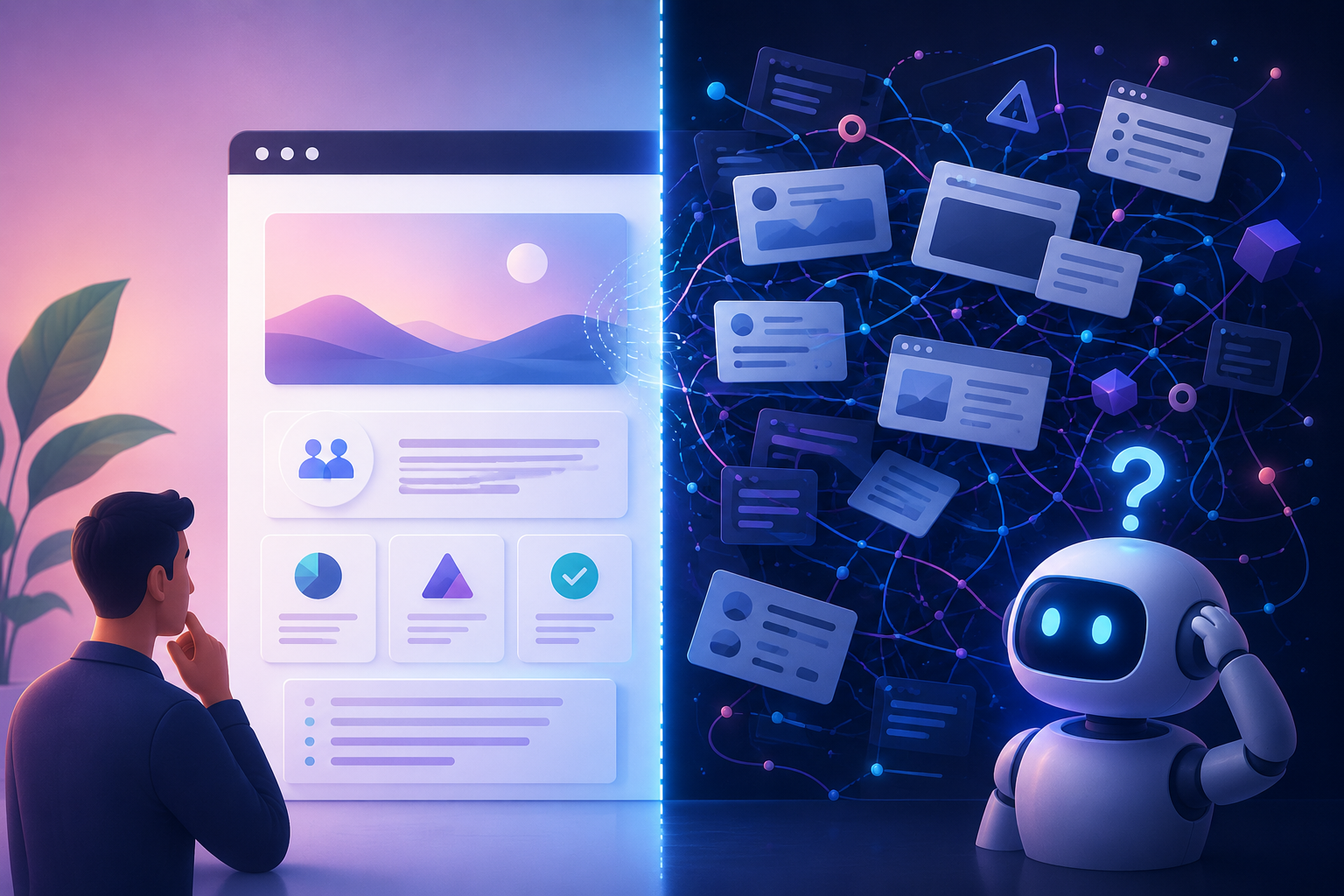
Why can a website make sense to people but still be difficult for AI to understand?
A website can feel perfectly clear to human visitors while remaining confusing to AI when its meaning depends on visual design, context, clever marketing language, or assumptions that are never explicitly stated. AI systems need stronger semantic signals: consistent descriptions of what the company does, clearly defined services, logical page relationships, descriptive headings, accessible content, and credible supporting evidence. When those signals conflict or are missing, AI may understand individual pages while struggling to form an accurate picture of the business. For B2B brands, that can affect how confidently the company is represented, cited, or considered during AI-assisted buyer research.
A prospect lands on your website.
Within seconds, they see your logo, navigation, product screenshots, client logos, headline, and carefully designed graphics. They understand the general idea. With a little browsing, they can fill in whatever information the website leaves unsaid.
An AI system approaches the same website differently.
It cannot always rely on the visual and contextual shortcuts that make sense to a person. Instead, it has to determine what your company is, what your terminology means, how different pages relate to each other, and which claims are important enough to carry into an answer.
That creates an increasingly important problem for B2B marketing teams:
A website can be beautifully designed, technically functional, and perfectly understandable to its existing customers while still sending weak or contradictory signals about what the company actually does.
As buyers increasingly use AI assistants to research companies before speaking with sales, that gap deserves attention.
Humans Are Very Good at Filling in the Blanks
Consider a homepage with this headline:
Powering What’s Next.
Underneath it sits an animation of enterprise teams connected through a digital platform, followed by customer logos and a button that says “Discover More.”
A human visitor can make inferences.
They may already know the company, recognize the customer logos, see screenshots, and understand that the company sells software. They can even navigate to another page when they need more information.
The headline itself does very little explanatory work.
Now imagine someone asks an AI assistant:
“What does this company do?”
The AI needs explicit information somewhere.
Is it a SaaS company? A consultancy? An MSP? An AI automation platform? A telecommunications provider?
Marketing language such as “transform,” “empower,” “accelerate,” “reimagine,” and “unlock” can communicate emotion and ambition beautifully. Yet without concrete language surrounding it, those words provide very little category information.
The issue is not that B2B websites need boring copy.
They need semantic anchors.
A strong website can say “Powering What’s Next” while also clearly establishing that the company provides, for example, managed cybersecurity services for mid-market financial institutions.
The creative message creates the impression.
The descriptive message creates understanding.
Your Website May Be Describing the Same Business Five Different Ways
One of the most common AI-readability problems is surprisingly simple: terminology drift.
It often happens gradually.
The homepage was rewritten during a rebrand.
Service pages were created by different teams.
Sales developed its own language.
Blog writers optimized articles around different keywords.
LinkedIn introduced another variation.
Over time, the same company might describe itself as:
- an AI transformation consultancy
- a digital innovation partner
- an enterprise automation company
- an AI solutions provider
- a business transformation agency
To a marketing team, these phrases may feel closely related.
To an outside system trying to establish exactly what the company should be associated with, they create ambiguity.
At Xeo Marketing, this is something we frequently look for when assessing AI visibility. Companies often assume they need substantially more content when the more immediate issue is that their existing content does not reinforce a consistent market position.
Twenty pages repeating a coherent area of expertise can create a clearer digital identity than one hundred pages describing the business differently.
Page Structure Is Part of the Message
AI confusion isn’t limited to copy.
Website architecture itself communicates meaning.
Imagine a cybersecurity consultancy with expertise in:
- AI risk assessments
- AI governance
- third-party AI vendor risk
- ISO 42001 readiness
- AI compliance programs
If all five offerings are briefly mentioned on a single generic “Solutions” page, the relationships between those areas remain weak.
A clearer architecture could give each important capability its own page and connect those pages to a broader AI governance hub, relevant articles, case studies, FAQs, and industry-specific applications.
Suddenly, the website communicates something larger than five individual services.
It communicates depth of expertise in a defined subject area.
Internal linking reinforces those relationships. Breadcrumbs clarify hierarchy. Descriptive navigation tells visitors what matters. Relevant supporting articles provide additional context.
This is why information architecture has become a marketing issue as much as a development issue.
Your sitemap is effectively a map of what your organization knows.
The Problem With “Everything on One Page”
Minimal websites can look fantastic.
For some businesses, they are also strategically appropriate.
But B2B companies selling complex services need enough information to establish context.
A service card that says:
AI Strategy
Turn artificial intelligence into competitive advantage.
may be visually elegant, but it leaves almost every meaningful question unanswered.
What does AI strategy include?
Who is it for?
Does the company develop AI systems, advise on adoption, assess risk, implement automation, or provide governance consulting?
How does the engagement work?
What expertise supports the service?
A buyer can contact sales to find out.
An AI assistant answering a buyer’s question may simply have stronger information about another company.
This is an important distinction.
Being present on the web is different from being explainable on the web.
Clear Service Positioning Makes Your Company Easier to Recommend
Suppose a buyer asks:
“Which firms help mid-market companies assess the risks of adopting generative AI?”
For your company to be a logical candidate, several pieces of information need to align.
Your website should make it clear that you:
- provide AI risk assessment services;
- work with mid-market organizations;
- understand generative AI risks;
- have relevant expertise or experience;
- can explain your methodology;
- have evidence supporting your credibility.
If your website only says that you “help organizations navigate the future of AI,” the connection is much weaker.
This is where positioning and AI visibility converge.
Good positioning reduces the amount of interpretation required to understand your business.
And the easier your company is to understand, the easier it becomes to associate it with the right buyer questions.
Content Needs Context, Not Just Keywords
Traditional SEO encouraged marketers to think carefully about keywords.
That remains useful, but AI-driven discovery introduces a broader question:
What does this page teach someone about our company and its expertise?
Consider a B2B marketing agency that publishes articles about:
- AI search
- Answer Engine Optimization
- B2B buyer behavior
- AI-readable websites
- AI visibility measurement
- content strategy for AI assistants
If those articles connect logically to relevant services, expertise, and each other, they collectively communicate an area of authority.
Now imagine the same company publishing high-volume articles about email subject lines, TikTok trends, logo design, e-commerce checkout optimization, influencer marketing, and AI search.
Each article might perform well individually.
Collectively, the picture of what the company specializes in becomes much less precise.
Content strategy therefore has an architectural dimension.
Every article adds another piece to the digital representation of your company.
Structured Data Helps, but It Cannot Fix Unclear Positioning
Schema markup and structured data are important components of a technically sound website.
They provide machine-readable information about entities such as organizations, articles, products, events, people, and other types of content. Schema.org provides the shared vocabulary widely used for this purpose, while Google Search Central’s structured data documentation explains how Google interprets structured data for search features.
But structured data should reinforce meaning that already exists.
If your visible website describes the company ambiguously, adding Organization schema does not suddenly create a clear market position.
If five service pages describe the same offering differently, markup does not resolve the strategic inconsistency.
Technical optimization works best when the underlying information is already coherent.
Think of structured data as a label on the box.
You still need to know what’s inside the box.
AI Needs Evidence to Understand What You Are Known For
Clear positioning answers:
What do you do?
Authority answers:
Why should anyone believe you?
A website built primarily around promotional claims may explain what the company wants to be known for without demonstrating that expertise.
This is why supporting content matters.
Case studies provide evidence of application.
Thought leadership demonstrates expertise.
Original research contributes something new.
Detailed service pages establish capabilities.
Executive bios connect expertise to real people.
Customer stories demonstrate outcomes.
FAQs answer specific questions.
External mentions provide independent context.
Together, these signals create a much richer representation of the organization than a homepage alone ever could.
For B2B companies, this matters because the questions buyers ask AI are often comparative:
Who specializes in this?
Which providers should we evaluate?
What companies have experience in our industry?
What are the differences between these vendors?
A clear website helps AI identify you.
A credible digital footprint gives it reasons to include you.
A Simple Test: Ask AI to Explain Your Company
Marketing teams can run a surprisingly useful diagnostic without touching their website.
Open several major AI assistants and ask the same questions:
- What does [company] do?
- What services does [company] offer?
- Who is [company] best suited for?
- What is [company] known for?
- How is [company] different from its competitors?
Then compare the answers with your actual positioning.
Don’t only look for factual errors.
Look for uncertainty.
Does one AI system categorize you as a software company while another describes you as a consultancy?
Are important services missing?
Is an old positioning statement still appearing?
Are competitors associated with capabilities that you also offer, while your company is absent?
These gaps can reveal something important about the information available across your digital footprint.
The next step is to investigate why the misunderstanding exists rather than simply trying to change the AI answer.
Often, the problem starts much closer to home.
Five Questions to Ask About Your Website
Before investing in another redesign, campaign, or content sprint, evaluate the website from the perspective of someone with absolutely no prior knowledge of your company.
1. Can they identify what you do in one sentence?
If five pages produce five different answers, tighten the positioning.
2. Does every major service have enough information to stand on its own?
A service deserves more than a title and three sentences if it is strategically important to the business.
3. Are related ideas visibly connected?
Services, case studies, articles, industries, and FAQs should reinforce each other.
4. Does your content demonstrate what you claim to know?
Expertise needs evidence.
5. Does the language remain consistent across the website?
Variation is natural. Contradiction is a problem.
These questions sound simple.
Answering them rigorously can reveal why a visually excellent website still underperforms in AI-driven discovery.
Your Website Is Becoming a Source, Not Just a Destination
This may be the biggest mindset shift.
For years, digital marketing strategy was designed around getting someone onto the website.
Search result → click → website → conversion.
AI-assisted discovery changes that sequence.
A buyer may learn about your company inside an AI-generated answer before visiting your site. They may compare you against competitors there. They may ask follow-up questions about your services, reputation, or specialization.
Your website therefore has another job.
It isn’t only a destination for traffic.
It is a source of information that helps the wider digital ecosystem understand your company.
That changes how marketers should think about website development.
Navigation still matters.
Conversion still matters.
Design still matters.
SEO still matters.
But semantic clarity, information architecture, content relationships, and consistency now deserve a seat at the same table.
About Xeo Marketing
Xeo Marketing is a Toronto-based digital strategy and innovation agency specializing in AI Engine Optimization (AEO), helping B2B service businesses adapt to AI-powered search and discovery. The AI Visibility Score is the first module in AOME (AI Orchestrated Marketing Engine), launching throughout 2025.
Learn more at xeo.marketing
