

Does LinkedIn influence how AI assistants understand and recommend B2B brands?
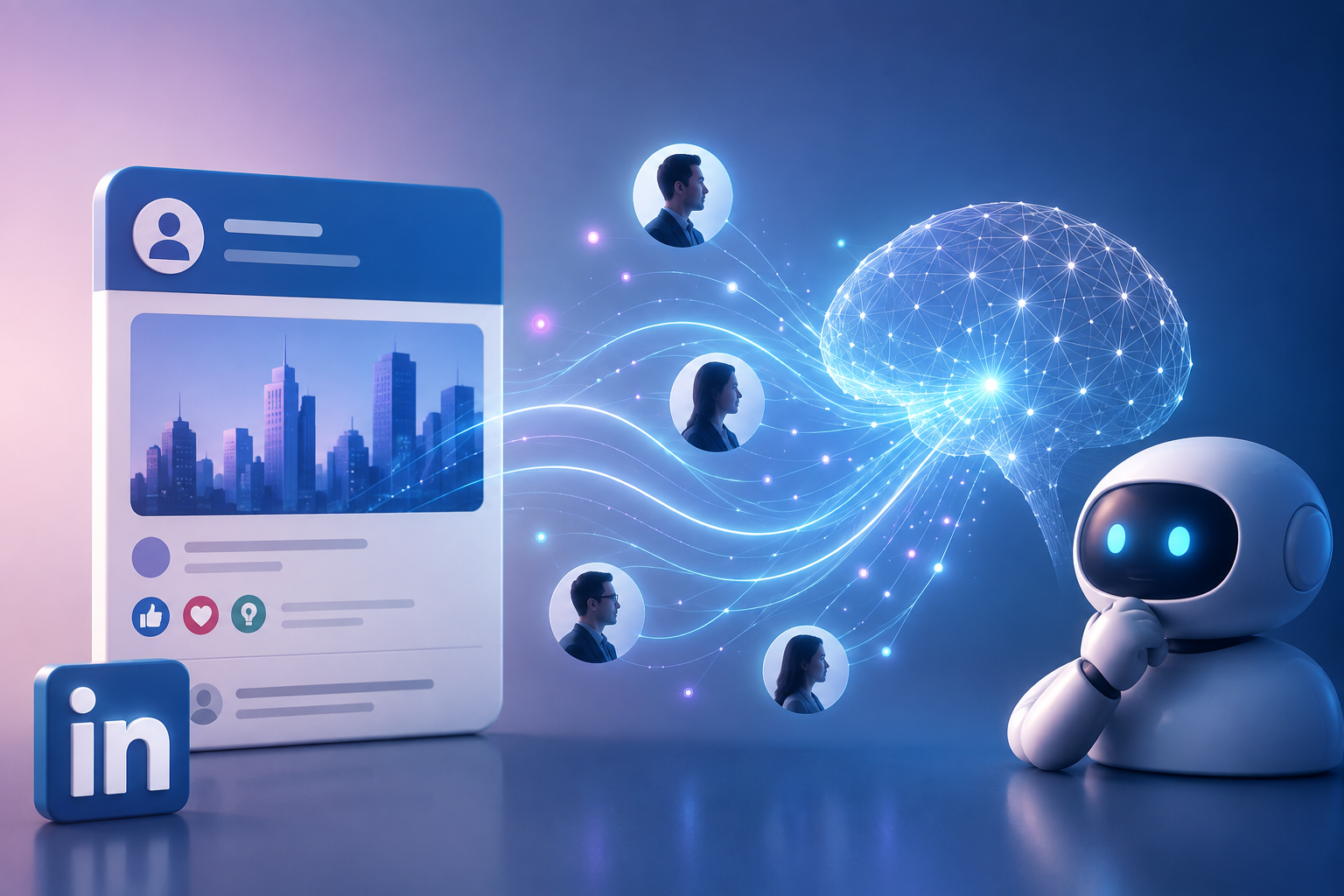
Yes, LinkedIn can influence how B2B brands appear in AI-powered discovery, although posting on LinkedIn does not automatically make ChatGPT or another AI assistant recommend your company. LinkedIn content can become part of the information AI search systems retrieve and cite when answering questions. Company Pages help establish brand identity and positioning, while executives and subject-matter experts contribute expertise, opinions, and first-hand knowledge. For B2B companies, the opportunity is therefore bigger than social reach: consistent, useful LinkedIn content can strengthen the digital evidence available when AI systems try to understand who your company is and what it knows.
For years, marketers have measured LinkedIn through familiar numbers: impressions, followers, reactions, comments, clicks, and leads.
Those metrics still matter.
But there is now another reason B2B companies should pay attention to what they publish.
Your next audience may never encounter the original post.
Instead, they may ask ChatGPT, Perplexity, or another AI assistant a question, and information published on LinkedIn may contribute to the answer they receive.
That changes LinkedIn’s role in the B2B content ecosystem.
LinkedIn Is Becoming Part of AI-Driven Discovery
There is now evidence that LinkedIn content is appearing directly in AI-generated answers.
In 2026, Semrush analyzed 89,000 unique LinkedIn URLs cited across ChatGPT Search, Google AI Mode, and Perplexity. LinkedIn ranked as the second-most-cited domain in its dataset and appeared in approximately 11% of AI responses on average. The rate varied considerably by platform: 14.3% for ChatGPT Search, 13.5% for Google AI Mode, and 5.3% for Perplexity. (Semrush)
That does not mean LinkedIn activity is a direct ranking factor for ChatGPT, nor does it prove that posting more frequently will cause an AI assistant to recommend your company.
It tells us something more useful:
Public LinkedIn content can become source material in AI-powered discovery.
That matters particularly for B2B brands because LinkedIn contains information that may not exist anywhere else.
A corporate website tells the market what a company officially does.
LinkedIn shows what that company and the people behind it are actively talking about.
Imagine a cybersecurity consultancy whose website says it specializes in AI governance.
On LinkedIn, its consultants regularly explain AI vendor risk, comment on regulatory changes, discuss ISO 42001 implementation, and share lessons from real projects.
Those posts create additional context around the company’s claimed expertise.
Now compare that with another consultancy whose website makes the same claim but whose executives rarely publish and whose Company Page mostly shares event announcements and promotional graphics.
The two companies may offer equally strong services.
Their digital evidence is very different.
What Gets Cited Is More Interesting Than What Goes Viral
One of the most useful findings from the Semrush research is that AI citation patterns do not look exactly like conventional social-media success.
The study found that 95% of cited LinkedIn posts were original rather than reshares. Educational and advice-oriented content represented the majority of cited posts, while the median cited post received only around 15–25 reactions and no more than one comment. (Semrush)
In other words, a post did not need to go viral to become useful source material.
That creates an interesting distinction for B2B marketers.
A highly entertaining post might generate thousands of impressions.
A detailed post answering:
“What should an enterprise buyer ask before purchasing an AI platform?”
may receive substantially less engagement.
Yet the second post contains something an AI system can potentially use: a clear answer to a real question.
This suggests B2B teams should think beyond social engagement when planning LinkedIn content. Some posts should generate conversation, or humanize the company, or promote products or events.
And some should deliberately capture the knowledge inside the organization.
That last category becomes particularly valuable in AI-driven discovery.
Write for retrieval, not just reaction
A subject-matter expert has far more to contribute than another generic “five trends to watch” post.
They can explain:
- why a common industry assumption is wrong;
- what they repeatedly see clients struggle with;
- how they evaluate a difficult decision;
- what changed in the market this year;
- what buyers should ask vendors;
- what happened during a real implementation.
Those are pieces of expertise that can exist beyond the company’s website.
Semrush’s analysis also found meaningful semantic overlap between cited LinkedIn content and the AI responses using it, suggesting that the ideas expressed in a LinkedIn source can carry through into the resulting answer. (Semrush)
For brands, that makes precise language important.
If your company wants to be known for a particular category, problem, or capability, the people representing it should be able to discuss that expertise clearly and consistently.
The Company Page and the People Behind It Play Different Roles
This is where B2B LinkedIn strategy becomes more interesting.
Should the company publish?
Or should executives publish?
The answer is both, because they provide different kinds of signals.
A Company Page establishes the official brand.
It communicates what the company does, the language it uses to describe itself, the markets it serves, its products and services, company developments, and its core areas of expertise.
An executive or subject-matter expert can contribute something different.
People have opinions.
They have experience.
They can explain what they learned from a client engagement, challenge an industry assumption, interpret a new regulation, or describe how they would approach a difficult problem.
Those first-hand perspectives can demonstrate expertise in a way that corporate messaging often cannot.
Interestingly, the Semrush study found different patterns across AI platforms. Perplexity cited Company Pages more heavily in its LinkedIn citations, while individual members accounted for a larger share in ChatGPT Search and Google AI Mode. (Semrush)
That reinforces an important point:
A B2B brand should not place its entire thought-leadership strategy inside the corporate account.
The strongest digital footprint is created when the organization and its experts reinforce each other.
For example:
Company Page:
“We help enterprises establish AI governance programs.”
Executive:
“Here are the three governance gaps we most frequently discover when companies begin deploying generative AI.”
Company blog:
“How to Build an Enterprise AI Governance Framework.”
Case study:
“How an organization developed its first AI risk assessment process.”
Different formats. Different voices. Same area of authority.
This is how scattered content becomes a coherent brand narrative.
LinkedIn Can Help AI Understand What Your Brand Is Known For
This is the strategic opportunity for B2B companies.
AI visibility is unlikely to be won through a single perfect LinkedIn post.
It develops through repeated, consistent signals around a subject.
Recent Semrush research into 1,094 subject areas in ChatGPT found that only about 15% of the categories studied had a clear brand leader, while more than half remained unsettled with no brand appearing consistently across even three of five related prompts. (Semrush)
That suggests there is still substantial room for brands to establish stronger associations with the topics that matter to their business.
LinkedIn can contribute to that effort.
Suppose an MSP wants to become associated with cybersecurity for mid-market organizations.
Its content strategy might consistently address questions such as:
- What cybersecurity risks are mid-market companies overlooking?
- How should businesses evaluate managed security providers?
- When does an organization need 24/7 security monitoring?
- How is AI changing cybersecurity risk?
- What should executives know before renewing cyber insurance?
The goal is not to repeat “we are cybersecurity experts” every week.
The goal is to demonstrate expertise from enough useful angles that the association becomes natural.
This is also where social media, SEO, AEO, PR, and content marketing begin to overlap.
A strong article can become a LinkedIn post.
An executive perspective can inspire an FAQ.
Original research can generate press coverage.
A customer question can become a thought-leadership article.
Instead of treating LinkedIn as an isolated social channel, marketers can treat it as one part of the brand’s wider knowledge footprint.
What Should B2B Marketing Teams Do Differently?
The practical implication is not “post more.”
It is publish more deliberately.
Start with the questions your customers actually ask.
Then identify the people inside the organization who genuinely understand those questions.
Marketing’s role is to help turn that expertise into clear, accessible content without removing the personality and experience that make it valuable.
A strong LinkedIn strategy for AI-era B2B marketing should therefore include:
- a clearly positioned and current Company Page;
- original posts from executives and subject-matter experts;
- consistent terminology around core services and categories;
- educational posts that answer specific buyer questions;
- first-hand experience and original observations;
- connections between LinkedIn content and deeper resources on the company website;
- regular monitoring of how the brand appears across AI assistants.
And there is one important principle behind all of them:
Do not publish for AI at the expense of people.
If a post genuinely helps a buyer understand an important issue, it already has the qualities that make it more useful across search, social media, and AI-assisted discovery.
LinkedIn Is No Longer Just a Distribution Channel
The old model of LinkedIn was relatively straightforward.
Create content.
Build an audience.
Generate engagement.
Drive people back to the website.
That model still exists, but another layer is forming around it.
Content published on LinkedIn can contribute to the wider information environment through which AI systems understand industries, topics, people, and brands.
For Xeo, this is why social media strategy increasingly connects with AI visibility strategy.
The question is no longer simply:
“How many people saw our LinkedIn post?”
Marketing teams should also be asking:
“What does our LinkedIn presence teach the market about what we know?”
Because as AI assistants become another layer between B2B companies and their buyers, the knowledge your company publishes may travel much further than the original post.
Your audience is still human.
But the path between your expertise and that audience is changing.
About Xeo Marketing
Xeo Marketing is a Toronto-based digital strategy and innovation agency specializing in AI Engine Optimization (AEO), helping B2B service businesses adapt to AI-powered search and discovery. The AI Visibility Score is the first module in AOME (AI Orchestrated Marketing Engine), launching throughout 2025.
Learn more at xeo.marketing
