

What does AI visibility actually improve?
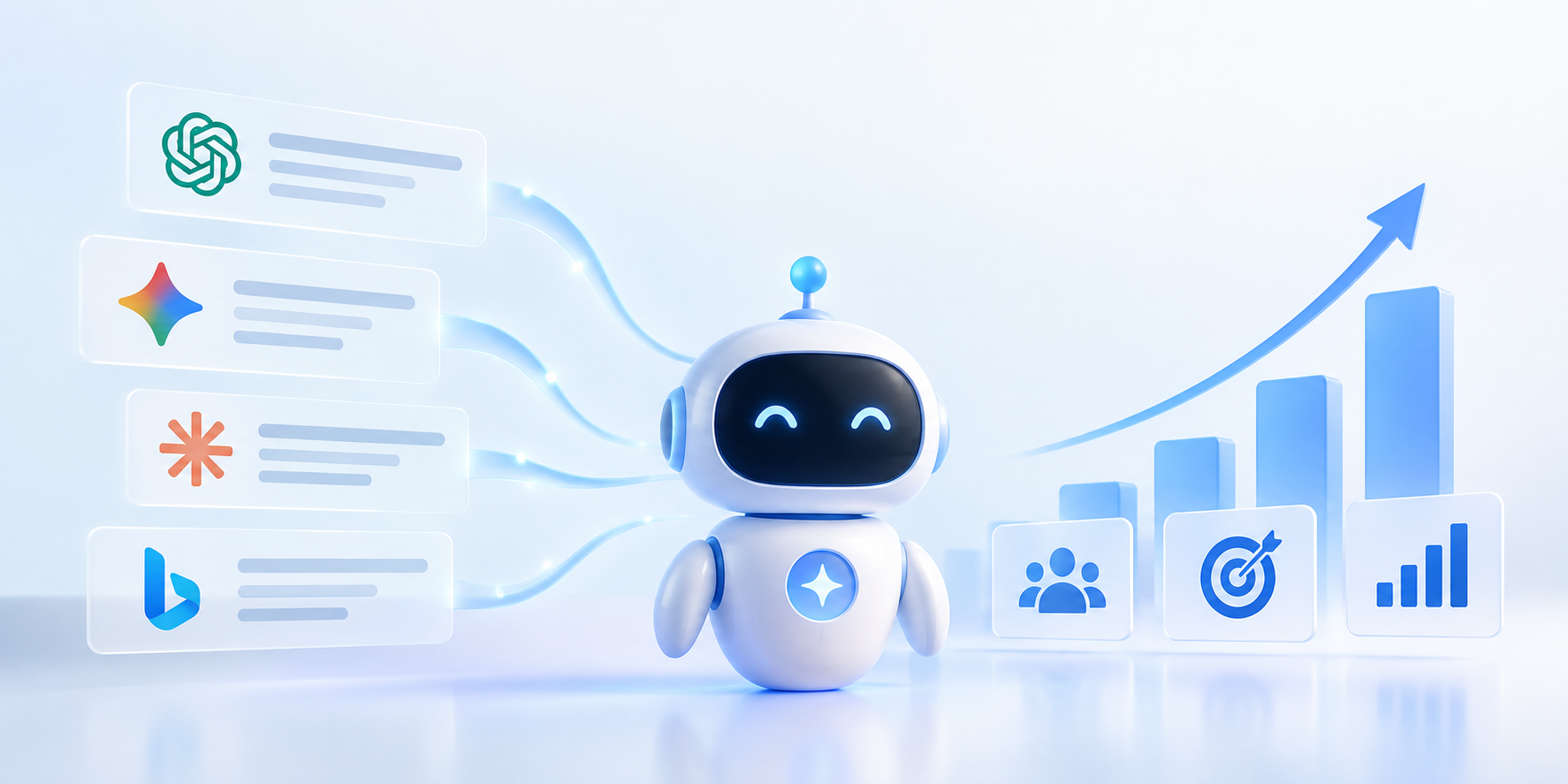
AI visibility can contribute to stronger brand discovery, more citations, increased branded search, qualified website traffic, buyer trust, lead quality, pipeline, and revenue. Measuring those outcomes requires looking beyond how often a company appears in ChatGPT, Gemini, Claude, Perplexity, and other AI platforms. Citations and share of AI visibility are useful leading indicators, while branded search, referral traffic, assisted conversions, pipeline influence, and revenue reveal what happens further along the buyer journey. A strong AEO measurement strategy connects these signals, showing whether greater visibility is influencing how buyers discover, evaluate, trust, and ultimately choose a company.
AI visibility is quickly becoming an important measurement category in B2B marketing.
Companies want to know how often ChatGPT mentions them. Marketing teams are building prompt libraries, monitoring citations, comparing competitors, and adopting platforms that track AI share of voice. These metrics provide useful information about a brand’s presence in AI-generated answers, especially as buyers incorporate AI assistants into vendor research.
The challenge comes when visibility itself becomes the scorecard.
A company could substantially increase its number of AI mentions without generating additional qualified opportunities. Another might appear less frequently overall while consistently showing up when buyers ask commercially important questions about its category.
From a business perspective, the second scenario may be far more valuable.
At Xeo Marketing, we believe AEO measurement needs to follow the buyer journey beyond the initial AI answer. Visibility tells us whether a brand is entering the conversation. The more important analysis looks at what changes after that happens.
Start With the Business Outcome
Consider an AI startup monitoring 100 prompts across ChatGPT, Gemini, Claude, and Perplexity.
At the beginning of the quarter, the company appears in 8% of relevant responses. Three months later, that figure reaches 22%.
On paper, the improvement looks significant.
A closer look might reveal that most of the new mentions come from broad informational prompts such as:
“What are some interesting AI companies?”
Meanwhile, the company remains largely absent from questions such as:
“Which AI platforms can automate enterprise procurement workflows?”
Both prompts contribute to an AI visibility score, yet they represent very different commercial opportunities.
The first may support general awareness. The second comes from someone researching a defined problem and potentially evaluating solutions.
Before selecting KPIs, marketing teams should therefore define the buyer behavior they hope greater AI visibility will influence.
An emerging company establishing a new category may prioritize awareness and association with that category. A more established business could focus on inclusion in vendor shortlists. Another organization may care primarily about qualified enterprise demand.
Once the outcome is clear, the metrics become much more meaningful.
AI Citations Show Where Your Brand Is Entering the Conversation
AI citations and mentions provide the first layer of measurement.
Marketing teams can track whether their company appears in relevant answers, whether their website is cited as a source, and which articles, service pages, research reports, case studies, or executive perspectives are being surfaced.
Those signals help establish whether a brand’s digital footprint is becoming accessible and useful within AI-driven discovery.
Citation volume alone provides limited context, though.
A citation explaining a broad industry term has a different commercial value from a citation within a vendor comparison. Similarly, an AI assistant referencing one of your articles differs from explicitly recommending your company as a potential solution.
A stronger analysis looks at the circumstances surrounding each appearance:
- Which prompts are generating citations?
- Where do those prompts sit in the buyer journey?
- Is the company being referenced as a source or recommended as a vendor?
- Which pages and topics generate the strongest visibility?
- What expertise is AI beginning to associate with the brand?
This context turns citation monitoring into strategic information.
A smaller number of appearances around highly relevant buying questions may create considerably more value than a large volume of generic mentions.
Share of AI Visibility Adds Competitive Context
Citation counts become more useful when viewed against the rest of the market.
Suppose your company appears across 30% of the prompts you monitor. That percentage looks strong until your closest competitor appears in 75%.
The opposite can happen as well. A 20% visibility share might represent category leadership when every competing brand remains below 10%.
Share of AI visibility helps answer a broader question:
When AI discusses the categories, problems, and buying questions that matter to our business, how visible are we compared with competitors?
Competitive analysis can reveal where another company has developed stronger topic authority, clearer positioning, more useful content, or better third-party validation.
It can also uncover open territory.
A strategically important topic with no dominant brand represents an opportunity to build an association before competitors establish one. For startups competing against larger organizations, these gaps can be particularly valuable because AI visibility does not always follow traditional market share.
Branded Search Can Reveal Downstream Interest
Some of AI’s influence happens outside AI platforms.
A buyer may encounter your company in a ChatGPT answer without clicking the citation. Later that day, they search Google for your brand, look up reviews, visit your LinkedIn page, or compare you against another vendor.
The analytics trail now attributes the website visit to search, social, or direct traffic even though the discovery moment happened somewhere else.
Branded search can help marketers identify this type of downstream behavior.
Useful queries to monitor include:
“[Brand] reviews”
“[Brand] pricing”
“[Brand] competitors”
“[Brand] vs [competitor]”
A rise in commercially relevant AI visibility accompanied by growing branded search creates a useful signal that buyer awareness may be changing.
That relationship needs to be interpreted carefully. Correlation does not establish direct attribution, particularly when PR, paid media, events, social content, and other campaigns are active at the same time.
Still, looking at these signals together gives marketers a more complete picture than AI referral traffic alone.
AI Referral Traffic Shows Only Part of the Journey
Referral traffic from ChatGPT, Perplexity, Gemini, and other AI platforms is among the most tangible AEO metrics because the interaction reaches the website directly.
Once visitors arrive, marketers can evaluate their behavior:
- Which pages attract AI referrals?
- How deeply do those visitors engage?
- Do they explore service or product pages?
- Are they returning later?
- How often do they convert?
- Do those conversions become qualified opportunities?
The quality of these sessions may prove particularly interesting for B2B companies.
Someone arriving through an AI assistant may have already asked several questions, explored the category, compared different approaches, and developed an initial understanding of the company. Their first website visit could therefore occur later in the research process than a traditional informational search visit.
Referral data still captures only the journeys where someone clicks directly from an AI platform.
A buyer who discovers your brand through ChatGPT and searches for it on Google tomorrow disappears from that referral dataset. A procurement manager who sees your company recommended by Perplexity and later types the URL directly does too.
For that reason, AI referral traffic works best as one component of a wider measurement model.
Organic Traffic May Become More Valuable Without Becoming Larger
For years, organic marketing performance has often been summarized through traffic growth.
AI-generated answers complicate that relationship.
Some informational searches can now be resolved without a website visit. A buyer looking for a simple definition or basic explanation may receive enough information directly from an AI assistant.
As a result, higher AI visibility does not automatically translate into dramatic increases in organic sessions.
Traffic quality may become more revealing.
A company could previously attract 1,000 visitors researching a broad definition. In an AI-assisted environment, perhaps only 400 visit the site, yet those visitors arrive with greater context and stronger commercial intent.
Looking only at sessions would suggest weaker performance.
Engagement, conversion rates, buyer fit, and pipeline contribution could tell the opposite story.
B2B marketing teams therefore need to examine what organic visitors actually do after they arrive. The relationship between visibility and value becomes much clearer when traffic volume is considered alongside intent and quality.
Lead Quality May Matter More Than Lead Volume
One of the most commercially important AEO outcomes may ultimately be lead quality.
Clear digital positioning helps AI systems understand what a company offers, which customers it serves, what problems it solves, and where its expertise is strongest.
That context can shape the buyers who eventually reach the business.
A prospect looking for something unrelated may recognize that the company is a poor fit before contacting sales. A buyer matching the ideal customer profile may arrive already understanding the offering and its relevance.
The result could be a healthier pipeline even if total inquiry volume remains relatively stable.
Marketing teams should therefore compare AI-influenced leads against broader demand generation using indicators such as ICP fit, sales acceptance rates, opportunity creation, average deal size, and progression through the funnel.
AEO becomes much easier to justify when visibility translates into better conversations rather than simply more conversations.
Assisted Conversions Reflect How B2B Buying Actually Works
A modern B2B journey might look like this:
LinkedIn post → ChatGPT research → Website → Google search → Case study → Direct visit → Demo request
Trying to assign that conversion entirely to the final direct visit misses most of the journey.
The same problem already exists across paid media, organic search, events, social media, email, and word of mouth. AI adds another influential research layer.
Assisted conversion analysis gives marketers a better way to think about this complexity.
Combining analytics with CRM data, self-reported attribution, sales feedback, AI referral traffic, branded search trends, and visibility monitoring can reveal recurring patterns that individual platforms cannot capture alone.
Perfect attribution is unlikely.
A credible body of evidence is far more realistic and, in many cases, more useful.
Revenue Influence Completes the Measurement Picture
Revenue remains the ultimate commercial outcome, particularly for companies investing significantly in AEO.
Reaching that point takes time.
B2B sales cycles can stretch across months, and waiting for closed revenue before evaluating every optimization decision would make an AEO program unnecessarily slow.
A more practical approach follows a sequence of indicators:
AI visibility → Buyer discovery → Brand validation → Website engagement → Qualified demand → Pipeline → Revenue
Each stage answers a different question.
Citations and visibility share indicate whether the company is entering relevant AI conversations.
Branded search and referral patterns show whether discovery behavior is changing.
Engagement and lead quality indicate whether the right audiences are responding.
Assisted conversions and pipeline connect that activity to commercial opportunities.
Revenue eventually shows how much business value the broader system is creating.
Looking at the full sequence prevents teams from expecting one metric to explain everything.
A Practical AI Visibility Measurement Framework
At Xeo Marketing, we recommend organizing AEO measurement into four layers.
Layer 1: AI Presence
Track citations, mentions, recommendations, competitor visibility, prompt-level performance, and share of AI visibility.
The objective here is to understand where the brand currently appears across relevant AI conversations.
Layer 2: Buyer Response
Monitor branded search, AI referral traffic, organic traffic patterns, engagement, returning visitors, and direct traffic.
These indicators help reveal whether stronger AI presence is translating into changes in discovery behavior.
Layer 3: Demand Quality
Evaluate qualified leads, ICP fit, sales acceptance, self-reported AI discovery, and assisted conversions.
At this stage, the focus shifts toward the quality of the buyers responding to that visibility.
Layer 4: Commercial Impact
Connect influenced opportunities with pipeline value, sales velocity, win rates, and revenue.
This final layer provides the clearest evidence of whether AI visibility is contributing to business growth.
Few companies will have perfect measurement across all four layers immediately.
That is fine.
The important step is building the connection gradually rather than allowing citation counts to become the endpoint of the strategy.
Define the Outcome Before You Optimize the Metric
For AI startups building their first AEO strategy, measurement should begin before the first prompt-tracking dashboard is configured.
Start by deciding what increased AI visibility should accomplish for the business.
A startup establishing a new category may prioritize awareness, topic association, citations, and branded search.
A company pursuing enterprise demand may care far more about appearing in high-intent vendor research, generating qualified leads, and influencing pipeline.
Those objectives should shape the prompts being monitored and the content being created around them.
From there, the measurement framework becomes much more coherent. Marketing can see which prompts matter, which sources influence them, how buyers respond, and where the strongest commercial signals emerge.
This also protects teams from a common problem in digital marketing: spending months optimizing a metric simply because it is easy to measure.
The Real Value of AI Visibility Appears Downstream
AI citations and visibility scores deserve a place in the modern B2B marketing dashboard. They help companies understand whether they are present as buyers increasingly use AI assistants to research markets, understand problems, compare solutions, and evaluate vendors.
Their commercial value becomes clearer further along the journey.
Greater visibility should eventually contribute to stronger branded demand, more relevant website engagement, better-informed buyers, higher-quality opportunities, pipeline, and revenue.
Some of those relationships will be measurable directly. Others will emerge through a combination of quantitative data and qualitative evidence from sales conversations.
At Xeo Marketing, we see this downstream perspective as an important distinction between tracking AI visibility and building an AEO measurement strategy.
A visibility score tells you where the brand appears today.
A strong measurement framework shows whether that presence is changing how buyers discover, evaluate, and choose the company.
That downstream change is where AI visibility begins to create business value.
About Xeo Marketing
Xeo Marketing is a Toronto-based digital strategy and innovation agency specializing in AI Engine Optimization (AEO), helping B2B service businesses adapt to AI-powered search and discovery. The AI Visibility Score is the first module in AOME (AI Orchestrated Marketing Engine), launching throughout 2025.
Learn more at xeo.marketing
