

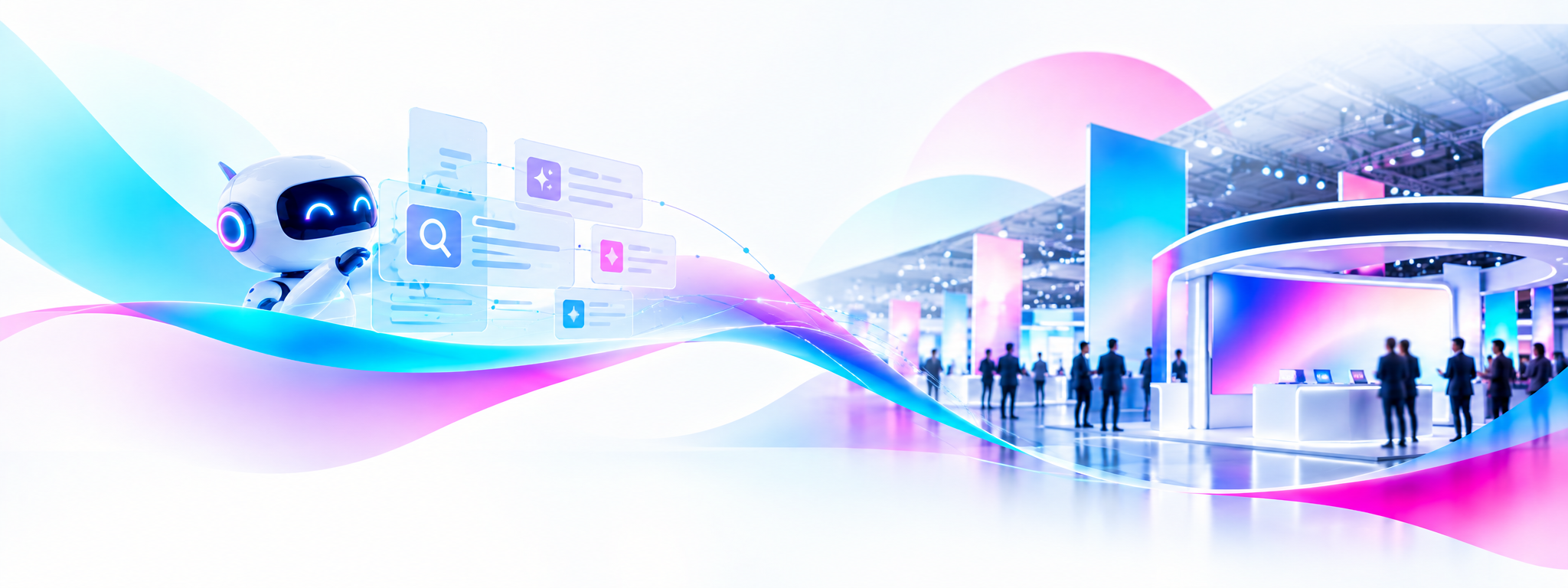
The way B2B buyers discover technology is changing.
A potential buyer researching an AI platform, cybersecurity solution or enterprise software category no longer needs to begin with a list of vendors and visit every website individually. They can ask ChatGPT, Gemini, Perplexity or another AI-powered discovery tool to explain the market, compare approaches, identify relevant vendors and narrow the options worth investigating.
That creates a new challenge for AI startups and B2B technology companies. Your brand may be competing for buyer attention before the buyer ever reaches your website, speaks with sales or sees one of your campaigns.
So where does that leave one of the oldest channels in B2B marketing: the in-person event?
It would be easy to assume that AI-driven discovery makes conferences, exhibitions and industry gatherings less important. In practice, they can play a different and potentially more strategic role.
AI can help buyers decide who deserves attention. In-person experiences can help them decide who deserves trust.
For marketers planning their 2027 mix, the question is therefore less about choosing between AI visibility and events. It is about understanding what each channel does in a buying journey increasingly shaped by both.
AI Is Moving Discovery Further Upstream
Traditional B2B marketing often assumes that discovery eventually brings a buyer into an environment the brand controls.
A search result leads to a website. An ad leads to a landing page. A campaign generates a form fill. From there, marketing and sales can begin nurturing the relationship.
AI-mediated discovery complicates that sequence.
A buyer can now ask an answer engine questions such as:
Which AI platforms can help automate customer support for a mid-sized enterprise?
What should I look for when evaluating an AI security vendor?
Which companies offer AI solutions for telecom operations?
The buyer may receive a synthesized answer containing explanations, comparisons and vendor recommendations before visiting any company website.
This makes AI visibility increasingly relevant to the top of the funnel. Companies need their expertise, positioning and evidence to be understandable enough for both people and AI systems to discover, interpret and reference.
But being surfaced in an answer is still only one part of a B2B buying decision.
Discovery creates consideration. It does not automatically create confidence.
AI Can Compress Research. It Cannot Remove Buyer Risk.
The more complex the purchase, the more important this distinction becomes.
An enterprise buyer evaluating an AI solution may need to understand far more than what the product claims to do. They may have questions about implementation, integration, data handling, security, governance, customization, support and how the technology performs within their particular environment.
AI can help organize that research.
A buyer can compare vendors, summarize documentation and generate questions for a sales conversation in minutes. In some cases, this may mean the buyer arrives much further into the evaluation process than before.
But a summarized answer cannot completely remove the risk associated with choosing a technology partner.
Eventually, someone may want to see the product demonstrated. A technical stakeholder may want to challenge an assumption. An executive may want to understand the team behind the company. A buyer may want to compare several solutions side by side.
That is where physical interaction can become particularly valuable.
The Role of Events Is Shifting From Discovery to Validation
Historically, trade shows often functioned as discovery engines.
Buyers walked an exhibition floor partly because they did not know what solutions existed. Vendors competed for visibility through booth placement, signage, demonstrations and giveaways.
That function has not disappeared, but AI gives buyers another way to perform the initial discovery work.
This changes what a strong event strategy should accomplish.
If a buyer can already learn the basics about your company online, repeating your homepage messaging at a booth adds limited value. The physical experience needs to give them something deeper.
For an AI or technology company, that might mean:
- demonstrating the solution against a realistic use case;
- giving buyers direct access to technical or product experts;
- answering implementation, security and governance questions;
- discussing a potential pilot or proof of concept;
- comparing approaches in a live conversation;
- meeting potential integration or channel partners;
- establishing credibility through speaking and thought leadership.
In that sense, an event can become a validation layer within an AI-mediated buying journey.
The buyer may discover you through an AI answer, encounter your content during independent research and then use an event to determine whether the company behind that digital presence is worth moving forward with.
AI Visibility and Physical Visibility Can Reinforce Each Other
This is why marketers should be careful about treating digital visibility and in-person events as competing budget lines with no relationship between them.
Consider a buyer preparing for an AI conference.
Before attending, they may ask an AI assistant which vendors are relevant to a particular problem. They may research exhibitors, speakers and topics. They might compare several companies and create a shortlist of booths or sessions worth visiting.
At the event, they meet those companies, see demonstrations and ask questions.
Afterward, they return online. They search the companies again, ask AI tools for comparisons, share information internally and continue evaluating the options.
The journey might look something like:
AI discovery → digital research → event interaction → deeper evaluation → sales conversation
Or it may begin at the event:
Event discovery → online research → AI-assisted comparison → follow-up → opportunity
Either way, online and offline discovery are interacting.
For marketers, this means an event should not be planned as a three-day activity isolated from the rest of the marketing strategy.
Before the Event: Make Sure Buyers Can Find and Understand You
If buyers are using AI to research companies before an event, your digital presence influences who arrives at your booth already interested.
This is where Answer Engine Optimization (AEO) and broader AI visibility become part of event planning.
Your website should clearly communicate what your company does, who it serves, which problems it solves and what differentiates its approach. Product pages, FAQs, case studies, executive perspectives and other authoritative content can provide the context that buyers need during research.
Event-related content can support that process too.
If your executives are speaking, explain the topic and why it matters. If you are demonstrating a particular solution, publish useful information around the problem it addresses. If the event targets a specific industry, make sure your relevant expertise is visible before attendees begin researching vendors.
The objective is straightforward: when a buyer researches the market before the event, your digital presence should support the conversation you want to have in person.
During the Event: Give Buyers What AI Cannot
If information is becoming easier to access, the value of simply distributing information declines.
A brochure listing product features can be summarized. A generic product description can be found online. A standard sales pitch can be delivered through a website.
The strongest in-person experiences should therefore concentrate on interaction.
Let buyers challenge your claims. Let them see the product. Give them access to people who can answer difficult technical questions. Understand the context behind their use case instead of rushing to scan another badge.
For AI companies in particular, these conversations can surface issues that rarely appear in a simple lead form: concerns about adoption, internal governance, data readiness, integration requirements, stakeholder resistance or the practical limitations of an AI initiative.
That information is valuable even before an opportunity is created.
The event becomes both a commercial channel and a source of direct market intelligence.
After the Event: Turn Physical Interaction Into Digital Momentum
One of the biggest mistakes in event marketing is treating the closing of the exhibition hall as the end of the campaign.
The strongest conversations should inform what happens next.
Questions repeatedly asked at the booth can become FAQs or articles. A presentation can be repurposed into thought leadership. A product demonstration can become a follow-up asset. Insights from buyer conversations can improve messaging and sales enablement.
Follow-up should also reflect what actually happened.
Someone who spent 30 minutes discussing a defined enterprise use case should not receive the same generic email as someone who scanned a badge while walking past the booth.
AI can help teams organize notes, summarize conversations, prioritize follow-up and repurpose event content, but the context captured by the people who had those conversations remains critical.
This creates a useful cycle:
Digital visibility creates event opportunities → event conversations create insight → insight improves digital content → stronger content improves future discovery.
Where Should Events Sit in the Marketing Mix?
There is no universal percentage of marketing budget that should go to events.
Their role depends on the market, sales model, deal value, buying cycle and what the company is trying to accomplish.
For an early-stage AI startup, a carefully selected event might provide access to buyers, partners and market feedback that would be difficult to generate elsewhere.
For an established B2B technology company, events may support account development, executive relationships, product launches or category authority.
The important distinction is that events should have a defined job within the wider marketing system.
Before approving an event, ask:
Who are we trying to reach?
Are the buyers, technical evaluators, partners or influencers that matter actually likely to be there?
What can we accomplish in person that our digital channels cannot accomplish as effectively?
A live demonstration, technical conversation or executive relationship may justify the investment more than simple awareness.
How will digital marketing support the event?
Consider pre-event AI visibility, content, account targeting, meeting preparation and post-event follow-up.
What outcome will determine whether the event worked?
Qualified meetings, opportunities, partnerships, pipeline and attributable realized revenue are more useful than booth traffic alone.
The event then becomes one component of an integrated buyer journey rather than an isolated campaign.
Choose Events for Audience Fit, Not Just Visibility
The expanding AI event landscape creates another problem: there are simply too many conferences to attend everything.
The biggest event is not automatically the best event.
A large technology conference may offer enormous reach but limited access to your actual buyers. A smaller vertical event may put your team in the same room as a concentrated group of decision-makers. A speaking opportunity may create more credibility than a large booth. Attending with a targeted meeting strategy may outperform an expensive sponsorship.
Xeo Marketing’s 2027 AI & B2B Technology Events Calendar brings together 21 AI conferences, technology expos and industry events worldwide to help companies start building their event shortlist.
From there, the 2027 AI Event Playbook provides a framework for evaluating audience fit, choosing whether to attend, exhibit, sponsor or speak, estimating the full investment and planning what happens before, during and after each event.
The objective is not to be everywhere. It is to identify the physical environments where being present can materially advance the buyer relationship.
Measure Events According to Their Actual Role
If events are increasingly supporting validation and deeper buyer engagement, measuring them primarily by lead volume becomes even less useful.
A booth can attract hundreds of visitors while producing very few meaningful conversations. Another event might generate only 15 qualified meetings but lead to several serious opportunities.
Those events should not be judged by the same surface-level metric.
A stronger measurement framework follows the commercial progression:
Total event investment → Qualified meetings → Opportunities → Pipeline → Attributable realized revenue
Xeo Marketing’s Free Event ROI Calculator was designed around this distinction. Teams can forecast event costs and potential commercial outcomes before participating, then return afterward to compare the estimate with actual investment, qualified meetings, opportunities, pipeline and realized revenue.
This also prevents another common problem: treating potential pipeline as if it were already revenue.
Events can influence valuable opportunities without every opportunity closing. Keeping forecast pipeline and realized return separate produces a more credible view of performance and a better basis for future budget decisions.
The Marketing Mix Is Becoming More Connected, Not Less
AI is changing how buyers find information, compare companies and decide what deserves further investigation.
That does not make physical interaction obsolete.
It changes what physical interaction needs to accomplish.
As basic information becomes easier to obtain, marketers can use digital and AI visibility to support discovery at scale while reserving in-person experiences for the moments where depth matters: demonstrating a solution, answering difficult questions, understanding a buyer’s context, building relationships and creating confidence.
For AI startups and B2B technology companies, the opportunity is to connect those environments deliberately.
Be discoverable before the event. Be useful when buyers research you. Give them a reason to engage when you meet. Capture what you learn. Continue the conversation digitally. Then measure whether those interactions progressed into genuine commercial outcomes.
In a buyer journey increasingly filtered by AI, events do not need to compete with digital discovery.
They need to do what digital discovery cannot do alone.
About Xeo Marketing
Xeo Marketing is a Toronto-based digital strategy and innovation agency specializing in AI Engine Optimization (AEO), helping B2B service businesses adapt to AI-powered search and discovery. The AI Visibility Score is the first module in AOME (AI Orchestrated Marketing Engine), launching throughout 2025.
Learn more at xeo.marketing
