


Creating an ecosystem by integrating products from different developers.
The business world today is more crowded than ever. An aftermath of Apple’s success was the influx of application developers and software providers. The market today is overflowing with software and apps for every tiniest of consumer problem or a business need. Whether it is for something as simple as a digitized grocery list, or for something more complex like booking a backpacking trip to multiple destinations across the globe with multiple variables, you can find an app for it…and not just one app but a whole selection of apps, each with its own distinct set of features and user experience.
Organizations need deep pockets with strong marketing budgets to even survive in this crowded world. So how do you compete and become a winner…
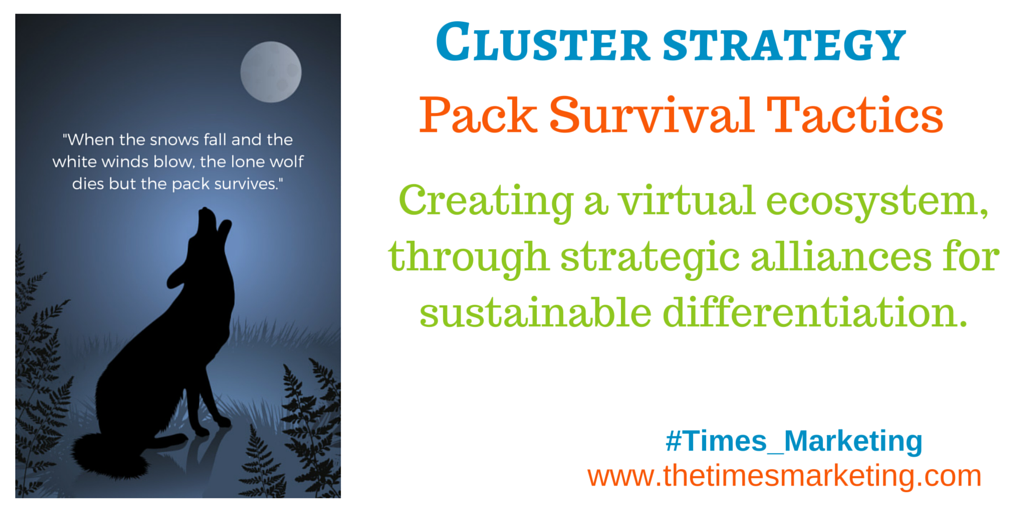
“When the snows fall and the white winds blow, the lone wolf dies but the pack survives.”
Cluster marketing, a newer term relates to creating sustainable differentiation by forming interdependent alliances with strategic partners to create a virtual #ecosystem.
Every Marketing pro has marvelled at the simplicity and the ingenuity of #Apple’s market strategy. But it wasn’t the perceived superior quality of the #Apple devices, nor the user-friendly innovative designs, but the tight #ecosystem of #hardware, #software and #content that locked the users for a long haul and gave #Apple a sustainable differentiation over the competition.
Not all of us can be Apple with self-sustained ecosystems, but we can always create one through strategic partnership…hence the birth of #Cluster Marketing Strategy!
Apple’s ace card or only created a sustainable differentiation for Apple it also heavily influenced the consumer buying habits and with it the product development, marketing, procurement and many other aspects of his business is done.
The Marketing pros, were of course more interested in understanding the dynamics of this differentiated strategy. Where the Marketing gurus from a decade ago talked about customer needs and created vertical silos – the Apple aftermath gave birth to a new #iGen entrepreneurs breed that picked a single customer problem and built a business by resolving that singular problem, giving birth to a whole new industry of application developers.
The initial boom resulting from this approach has encouraged businesses across the globe to continue pursuing this avenue. With everyone jumping in, to grab a piece of the pie, the market space is now heavily crowded with businesses start-ups and incumbent alike struggling to stay above water.
Cluster marketing strategy has worked well for me; both as a marketing prime in the corporate world and as an independent consultant for the start-ups and small businesses. Finding products or services, many a times from an absolutely diverse segment to create integrated solutions has resulted in getting the much desired, sustainable differentiation even for the most horizontal or generic product. While each application address a singular problem, in reality the end user prefers a solution that addresses the entire end-to-end process.
Creating differentiation through Cluster Marketing Strategy:
1. The first action then is to step into the customer’s shoes and understand how the customer would use your product/service. For e.g. As a marketing prime in the Telecommunication world we were looking to promote a new co-location facility. As an incumbent service provider a co-location essentially means selling Space and Power and what could truly be different about Space and Power. I stepped into the show of the customer and thought about how they would use the colocation facility and found three distinct customer requirements a) Storage b) Network Management c) Multi-tenant Internet base.
For each of these use-case the customer required different elements on of the space and power to truly get a complete solution. To use the space for Storage the customer also needed storage racks and space so we partnered with a storage solution provider to enable a complete solution for the client. For Network management, the customer would need routers and so we partnered with OEM manufacturers to create the integrated solution for them and so on and so forth…
2. The next step of course is to identify partners that would provide not just a solution but will also fit well with your organization’s core culture. For large organizations this could mean associating with other Brands that share similar social views and brand status. For start-ups it could mean bringing partners that can provide multi-dimensional support. How well connected are they on the social media? Are they well-respected within the target community. What clients do they have? Do they have extensive presence in certain verticals? Do they have intensive knowledge of a regulated industry?
3. The Final step is to create an integrated solution using multiple partners. The key here is not just the product or the service that you are trying to deliver but also how well you can utilize the available resources. Promote not just on your website and social media site but also on the partner sites. If you are tweeting about the product make sure you hashtag the partners in there to create a natural snowball effect.
An example that comes to my mind is that of a digital signature company. With multiple big names in the mix, this small software company that specialized in the Suerty and Insurance industry was finding it difficult to compete. Our recommendation was simple:
- Reach out to few strategic cloud service providers – another segment that was struggling to find a differentiation,
- Create a industry-specific solution using digital signature product of the software developer and the document preservation service from cloud service providers and
- Market the integrated product within the target industries
Needless to say, not only did the product sell well, they moved on to finding several other niche markets and offering them software + cloud packages specific to their requirements. The software provider was able to create a differentiation against his own competition and the Cloud service provider was able to do the same within his own circle. This marriage also exposed them to each other’s clients and possible target markets, opening doors that they couldn’t even imagine if they had confined themselves to their own product vision.
Cluster marketing is not just about partnering to create a semi-integrated product – it is about creating a strategic ecosystem by leveraging the strengths of your partners, utilizing all available resources and optimizing the reach. Your innovative product/solution is the reason your customers will choose you but it is the integration of the end-solution that will keep them with you for a longer time.
