

Even the smallest purchase rarely happens instantly.
People go through a journey before they decide. They become aware of a need, a question, a frustration, or a problem they are trying to make sense of. Then they start looking for answers.
That discovery journey has changed over time.
A few decades ago, buyers might have discovered products through a store visit, a trade show, a newspaper ad, a magazine feature, a referral, or a conversation with a salesperson. Then the internet changed everything. Buyers started searching online, reading reviews, comparing websites, joining webinars, and doing far more research on their own.
Today, AI is changing the journey again. According to Forrester’s 2024 Buyers’ Journey Survey, 89% of B2B buyers had already adopted generative AI as part of their buying process. By 2025, Forrester reported that adoption had grown to 94%, with buyers naming generative AI and conversational search as one of their most meaningful sources of information. Gartner also found that 67% of B2B buyers now prefer a rep-free experience.
That means buyers are not waiting for a sales conversation to understand the market.
They Google, ask ChatGPT, skim analyst reports, social posts, and customer reviews. They compare opinions. And somewhere along the way, their thinking starts to shift.
First, they are trying to understand the problem. Then they are trying to figure out their options. Eventually, they are deciding who they trust enough to work with.
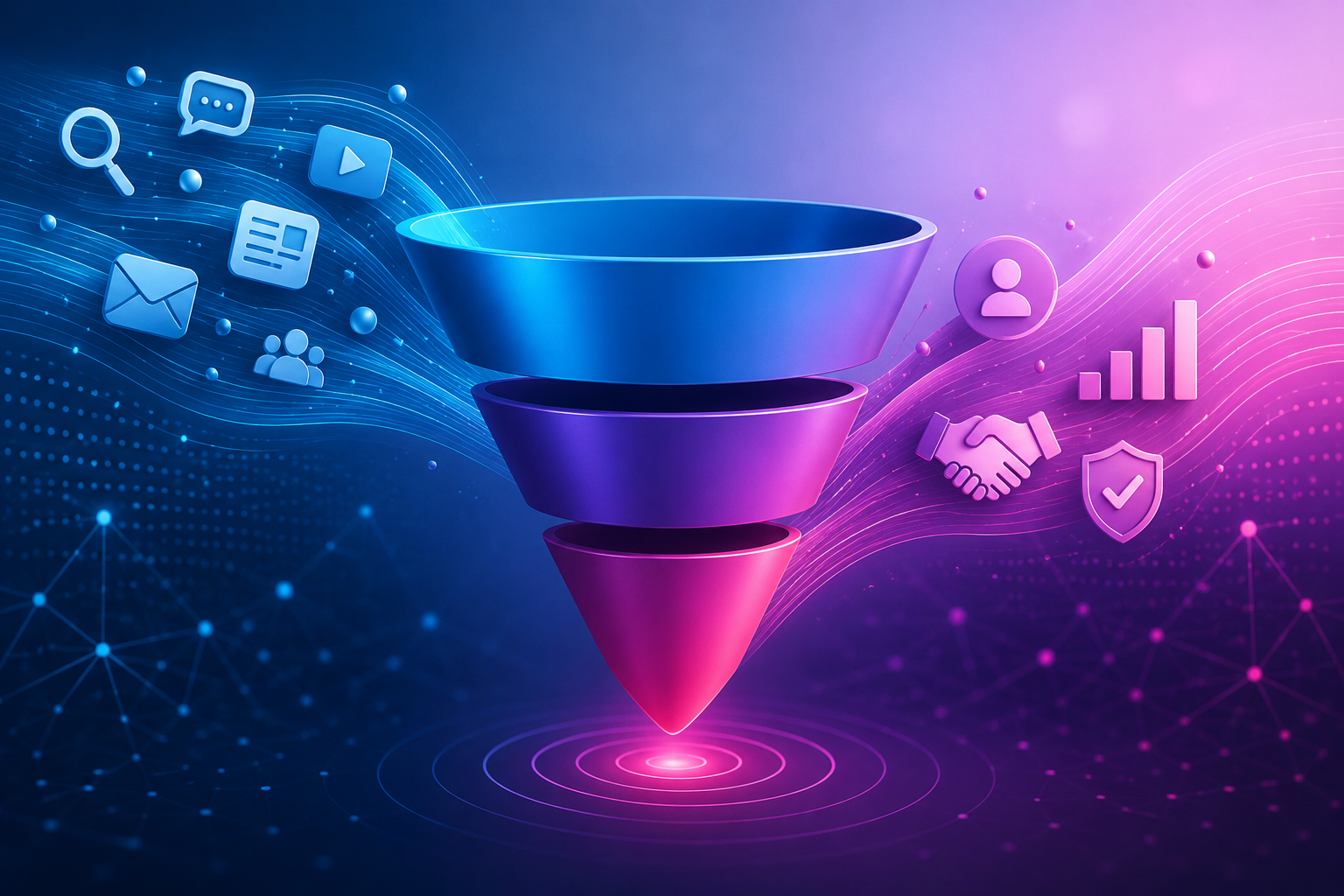
That pattern is not new. Marketers have described versions of it for decades through models like AIDA — awareness, interest, desire, and action — and more recently through TOFU, MOFU, and BOFU: top of funnel, middle of funnel, and bottom of funnel.
In B2B, this journey matters even more. The higher the investment, the more considered the decision. More people get involved, more proof is needed. And more trust has to be built.
What has changed is how quickly buyers now move through the journey, and how much of it is shaped by AI before they ever reach your website, fill out a form, or speak to your sales team.
How TOFU, MOFU, BOFU Map to Buyer Intent?
TOFU, MOFU, and BOFU are often described as awareness, consideration, and decision stages.
But the real value of the funnel is not the terminology. It is what it tells us about how buyer intent changes.
A buyer who is just becoming aware of a problem is not looking for the same information, or searching in the same places, as a buyer who is comparing vendors. And a buyer who is close to making a decision needs a very different level of confidence than someone who is simply trying to understand the issue.
Early in the journey, buyers often turn to broader, easier-to-access channels. They scan LinkedIn. They follow conversations on social media, read industry posts, newsletters, thought leadership, community discussions, and AI-generated summaries. At this stage, they are gathering context without committing too much time or attention.
As their interest grows, they move closer to the source. They search more deliberately, compare approaches, visit company websites, read case studies, guides, analyst perspectives, reviews, and expert commentary, and may ask ChatGPT or Perplexity to explain trade-offs, compare options, or help them make sense of the market.
By the time they are closer to a decision, the question changes again. They are no longer just trying to understand the category but want proof, trust, and to know whether the company can actually deliver. This is when buyers may look for implementation details, client results, pricing clarity, references, demos, direct conversations, or validation from analysts, peers, partners, and sales teams.
Why This Matters for Marketing Strategy
This is why TOFU, MOFU, and BOFU still matter.
They are not just campaign stages. They are stages of buyer confidence.
For marketing strategists, this matters because effective marketing is not only about creating more assets. It is about understanding what the buyer needs at each stage, where they are likely to look for it, and what kind of signal will help them move forward.
AI may compress the journey, but it does not remove the need for trust to be built in stages.
The funnel still matters because buyers still move from curiosity to clarity, from clarity to comparison, and from comparison to confidence.
TOFU: Helping Buyers Understand Their Problem
At the awareness stage, buyers are rarely searching for vendors.
They are searching for understanding.
Instead of contacting sales, they usually consume freely available information across the web. They might discover a topic through a LinkedIn post, an industry newsletter, a YouTube video, a Google search, an AI assistant like ChatGPT or Perplexity, or recommendations shared within professional communities.
Someone might ask:
Cybersecurity
- How can we safely adopt AI in our organization?
- What are the biggest AI security risks for businesses?
- Does my company need an AI risk assessment?
AI-Powered B2B SaaS
- How can AI improve the online shopping experience?
- What is an AI-powered commerce platform?
- How are retailers using AI to increase conversions?
Luxury Real Estate
- Why are more international buyers investing in The Bahamas?
- What should I look for in a luxury beachfront property?
- Can buying property in The Bahamas support residency?
Educational content performs best here because buyers are gathering information rather than evaluating suppliers.
Common TOFU channels include:
- Organic search (Google & AI search)
- Social media
- Industry blogs
- YouTube
- Podcasts
- Webinars
- Newsletters
The objective is simple: become a trusted source before competitors become part of the conversation.
This version is closer to what Monali was asking for: the questions reflect real buyer intent across different industries without mentioning specific client names.
MOFU: Turning Interest Into Confidence
Once buyers understand the problem, they begin narrowing their options.
Rather than consuming broad educational content, they start looking for information that helps them compare solutions and validate potential partners. This often means visiting company websites, downloading gated resources, reading customer stories, attending product webinars, speaking with sales teams, or requesting demonstrations.
Strong MOFU content includes:
- comparison articles
- implementation guides
- case studies
- strategy frameworks
- ROI calculators
- webinars
Common MOFU channels include:
- Company websites
- Resource centers
- Email nurturing
- Product webinars
- Downloadable guides
- Sales conversations
- Product comparison pages
The goal shifts from creating awareness to building confidence.
BOFU: Reducing Risk Before the Decision
By the time buyers reach the bottom of the funnel, they usually know which vendors they’re considering.
Now they are looking for reassurance.
They want independent validation that they are making the right decision. Buyers often turn to analyst reports, customer reviews, implementation discussions, references, product demonstrations, and detailed pricing conversations before signing a contract.
Typical BOFU assets include:
- customer success stories
- testimonials
- live demos
- consultations
- pricing pages
- implementation plans
Common BOFU channels include:
- Analyst reports (Gartner, Forrester, IDC)
- G2 and Capterra reviews
- Customer references
- Product demos
- Pricing discussions
- Sales proposals
At this stage, every interaction should reduce uncertainty and reinforce trust.
Why Many Marketing Strategies Underperform
One of the biggest mistakes companies make is creating content almost exclusively for one stage of the funnel.
Some publish dozens of educational articles but offer little proof that they can deliver results.
Others focus almost entirely on service pages and sales messaging without first earning trust.
Neither approach creates a sustainable pipeline.
High-performing marketing strategies connect all three stages.
Awareness creates attention.
Consideration builds confidence.
Decision content drives action.
The funnel works because every stage prepares buyers for the next.
AI Has Changed the Journey—Not the Funnel
AI assistants are compressing buyer research.
Instead of opening twenty browser tabs, buyers increasingly ask ChatGPT or Perplexity to summarize options, compare vendors, and explain unfamiliar topics.
This means prospects often arrive on your website much better informed than before.
Google recognized this shift years ago through its concept of the Zero Moment of Truth (ZMOT), describing how buyers complete much of their research before interacting with a business. Winning the Zero Moment of Truth (Google)
The implication for marketers is clear.
Every piece of content should be designed not only for human readers but also to help answer engines accurately interpret your expertise.
Audit Your Content by Funnel Stage
A simple exercise can reveal significant gaps in your marketing strategy.
List every major content asset your company has produced.
Then ask:
- Does this help someone understand a problem? (TOFU)
- Does it help evaluate solutions? (MOFU)
- Does it help someone make a confident purchase? (BOFU)
Many organizations discover they have dozens of awareness articles but very little content supporting evaluation or decision-making.
Others realize they have product pages without enough educational content to attract new audiences.
A balanced content library supports the entire customer journey instead of only one stage.
The Best Marketing Strategy Matches Buyer Intent
TOFU, MOFU, and BOFU are not simply marketing acronyms.
They represent the changing information needs of real buyers.
Channels will continue to evolve.
Search engines will become answer engines.
AI assistants will continue to reshape discovery.
But one principle is unlikely to change:
People need different information before they are ready to make a decision.
The brands that recognize those changing needs—and create content that supports every stage of the journey—will build stronger relationships, generate better-qualified leads, and create marketing strategies that continue to perform regardless of how buyers choose to search.s buyers see first.
About Xeo Marketing
Xeo Marketing is a Toronto-based digital strategy and innovation agency specializing in AI Engine Optimization (AEO), helping B2B service businesses adapt to AI-powered search and discovery. The AI Visibility Score is the first module in AOME (AI Orchestrated Marketing Engine), launching throughout 2025.
Learn more at xeo.marketing
