

As 2025 closes, one thing is clear: B2B marketing didn’t just evolve this year — it fractured.
Some teams are experimenting with AI tools at the edges. Others are quietly losing influence as buyers move upstream, asking AI systems for answers long before marketing ever sees a click.
And then there’s the signal the industry itself just sent.
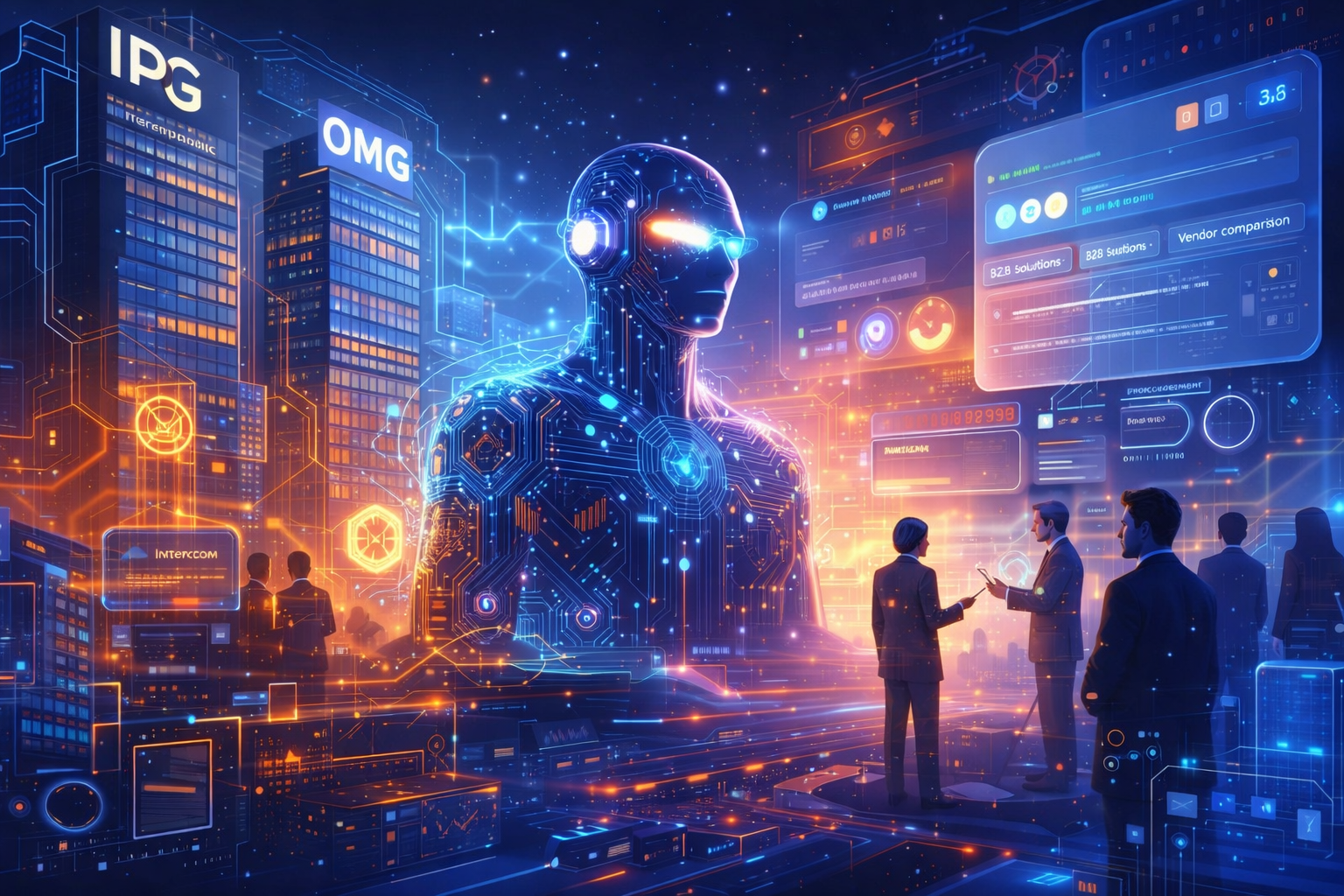
In late 2024, Omnicom Group announced its acquisition of Interpublic Group — a consolidation that would have been unthinkable a decade ago. On the surface, it looks like a scale. Underneath, it’s something else entirely: defensive positioning in a market where traditional agency leverage is eroding. And this had already been occurring throughout the entire year of 2025.
This matters more than most B2B marketers realize.
Discovery Is No Longer a Funnel — It’s a DecisioThe Holding Company Signal: Efficiency Over Differentiation
The IPG–Omnicom move isn’t about creative brilliance or bold innovation. It’s about margin pressure, procurement-driven buying, and survival in a world where:
- Media buying is increasingly automated
- Creative is increasingly commoditized
- Strategy is being questioned by CFOs, not CMOs
When the largest agency networks consolidate, it usually signals that growth is no longer coming from expansion — it’s coming from efficiency.
For B2B brands, that has consequences.
It means fewer partners willing to go deep.
More standardized playbooks.
More emphasis on output than understanding.
And that’s exactly where AI begins to reshape the landscape.
AI Is Not Replacing Marketing — It’s Replacing Discovery
The biggest misconception we still hear is that AI is “another channel.”
It’s not.
AI is becoming the primary discovery layer.
When a buyer asks:
“What are the best UCaaS providers for mid-market healthcare?”
They are no longer entering a funnel. They are receiving a curated answer set, generated from:
- Structured data
- Clear positioning
- Authority signals
- Contextual relevance
By 2026, this behavior won’t be edge-case — it will be normal, especially for:
- Technical buyers
- Procurement-led evaluations
- Time-constrained executives
Traditional SEO doesn’t break here because it’s “bad.”
It breaks because it was designed for a click-based world, not an answer-based one.
The Uncomfortable Truth: AI Is Selective by Design
AI systems don’t aim to be fair.
They aim to be useful.
That means:
- Most brands will never be mentioned
- Being “good” is not enough
- Vague positioning is invisible
This creates a widening gap between companies that are AI-legible and those that are not.
And here’s the part no one likes to say out loud:
AI will amplify existing asymmetry.
The brands that already have clarity, consistency, and credibility will compound their advantage. Everyone else will quietly disappear from consideration — without ever knowing why.
What AI-First B2B Marketing Actually Requires in 2026
AI-first does not mean chasing every generative tool.
It means rethinking fundamentals:
1. Positioning Must Be Machine-Readable
AI cannot infer what you mean. It only works with what you state clearly.
If your website can’t answer:
- Who you are
- What category you belong to
- Who you serve
- Why you’re different
…AI won’t guess.
2. Authority Becomes Structured, Not Perceived
In a human world, authority could be implied through design and brand polish.
In an AI world, authority is inferred through:
- Citations
- Consistency across sources
- Explicit signals of expertise
- Verifiable claims
3. Websites Become Knowledge Sources, Not Brochures
AI doesn’t “see” your site — it interprets it.
Your website becomes training input, not just a destination.
This is why many B2B teams feel a disconnect:
“Our traffic is down, but deals are still influenced by something we can’t track.”
That “something” is AI interpretation.
Why Big Agencies Will Struggle — and Specialists Will Win
Holding companies optimize for scale.
AI-first marketing optimizes for understanding.
Those are opposing incentives.
Large agencies are structurally slow to:
- Redesign messaging around AI legibility
- Rebuild sites for machine comprehension
- Measure visibility beyond clicks and impressions
Specialist firms — especially those focused on AI visibility, Answer Engine Optimization (AEO), and structured discovery — are better positioned because they are not defending legacy models.
This is not a creative shift.
It’s an infrastructure shift.
Where Xeo Fits In
At Xeo, we don’t believe AI is a replacement for strategy — we believe it demands better strategy.
As the industry consolidates and automation accelerates, our focus remains simple:
- Help brands understand how AI sees them
- Make visibility measurable
- Build marketing systems that work with AI, not against it
2026 won’t reward noise.
It will reward clarity.
And we’ll be here — helping our clients navigate that reality, long after the headlines fade.
About Xeo Marketing
Xeo Marketing is a Toronto-based digital strategy and innovation agency specializing in AI Engine Optimization (AEO), helping B2B service businesses adapt to AI-powered search and discovery. The AI Visibility Score is the first module in AOME (AI Orchestrated Marketing Engine), launching throughout 2025.
Learn more at xeo.marketing
